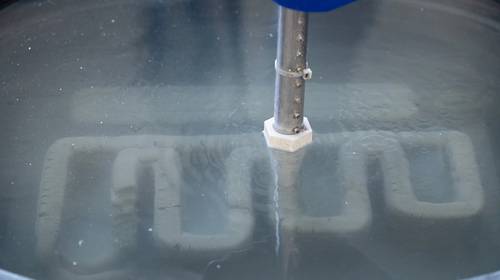
Cornell University researchers are pioneering an effort to extend 3D printing technology into the ocean, developing an innovative method to print concrete directly underwater. Funded by DARPA, the project aims to enable intelligent, non-destructive construction and repair of subsea infrastructure.
(Underwater Concrete 3D Printing)
Traditional underwater construction faces significant challenges, notably the “washout” problem where cement is easily dispersed by water currents. Project lead Professor Sriramya Nair highlights the team’s core breakthrough in material formulation: they have successfully developed a specialized concrete primarily composed of seafloor sediment. This mixture significantly reduces the amount of cement required and its associated transport costs, while effectively resisting erosion in the underwater environment.
This technology involves more than just material science; it is an integrated systems engineering challenge. The team brings together interdisciplinary experts in materials science, robotics, and architectural design. They have equipped robotic arms with specialized sensors to navigate the turbid underwater conditions, enabling real-time monitoring and adjustment of the printing path.
The team is currently conducting intensive testing in a laboratory water tank in preparation for DARPA’s final underwater “bake-off” competition next March, where participating teams must demonstrate the on-site printing of an underwater arch structure. If successful, this research could fundamentally transform maritime construction practices, realizing the vision of intelligent building with “minimal disturbance to the ocean.”
Roger Luo said:This research transforms marine construction by turning local sediment into structural material, drastically cutting cost and environmental impact. The real challenge lies in scaling the system for dynamic ocean environments and ensuring long-term durability against currents and biofouling.
All articles and pictures are from the Internet. If there are any copyright issues, please contact us in time to delete.
Inquiry us
Related Posts

The Indestructible Vessel: The Alumina Ceramic Crucible Legacy alumina silica
Intro: The Crucible of Creation In the world of materials scientific research, where the alchemy of warmth transforms base components right into...
Read out all
The Elemental Bond: The Molybdenum Disulfide Revolution moly disulfide powder
Intro: The Smooth Frontier In the high-stakes theater of modern sector, where metal grinds against steel and warmth threatens to eat progress,...
Read out all
The Molecular Revolution: Redefining Performance with Advanced Plasticiser waterproof admix
Intro: The Scientific Research of Flow In the substantial and requiring landscape of contemporary building and construction, where structural integrity meets building...
Read out all
The Molecular Revolution: Redefining Performance with Advanced Plasticiser waterproof admix
Intro: The Scientific Research of Circulation In the vast and demanding landscape of contemporary construction, where architectural stability satisfies architectural passion, there...
Read out all
Why Boron Nitride Ceramic Is Ideal for Crucibles in Strontium Barium Niobate Crystal Growth
Boron nitride ceramic has become the top choice for crucibles used in growing strontium barium niobate crystals. This material stands out because...
Read out all
What Are the Boron Nitride Ceramic Applications in High Temperature Globe Control Valves
Boron nitride ceramic is now being used in high temperature globe control valves. This material brings strong performance where heat and pressure...
Read out all